Free DOCX preflight
Publishing glossary
Manuscript: the finished text before it becomes a book.
A manuscript is the complete, edited text of a book before typesetting; standard manuscript format is what makes it convertible.
Checked:
✓Draft to manuscript means structural edits done✓DOCX is the standard manuscript format✓Manuscript formatting precedes layout
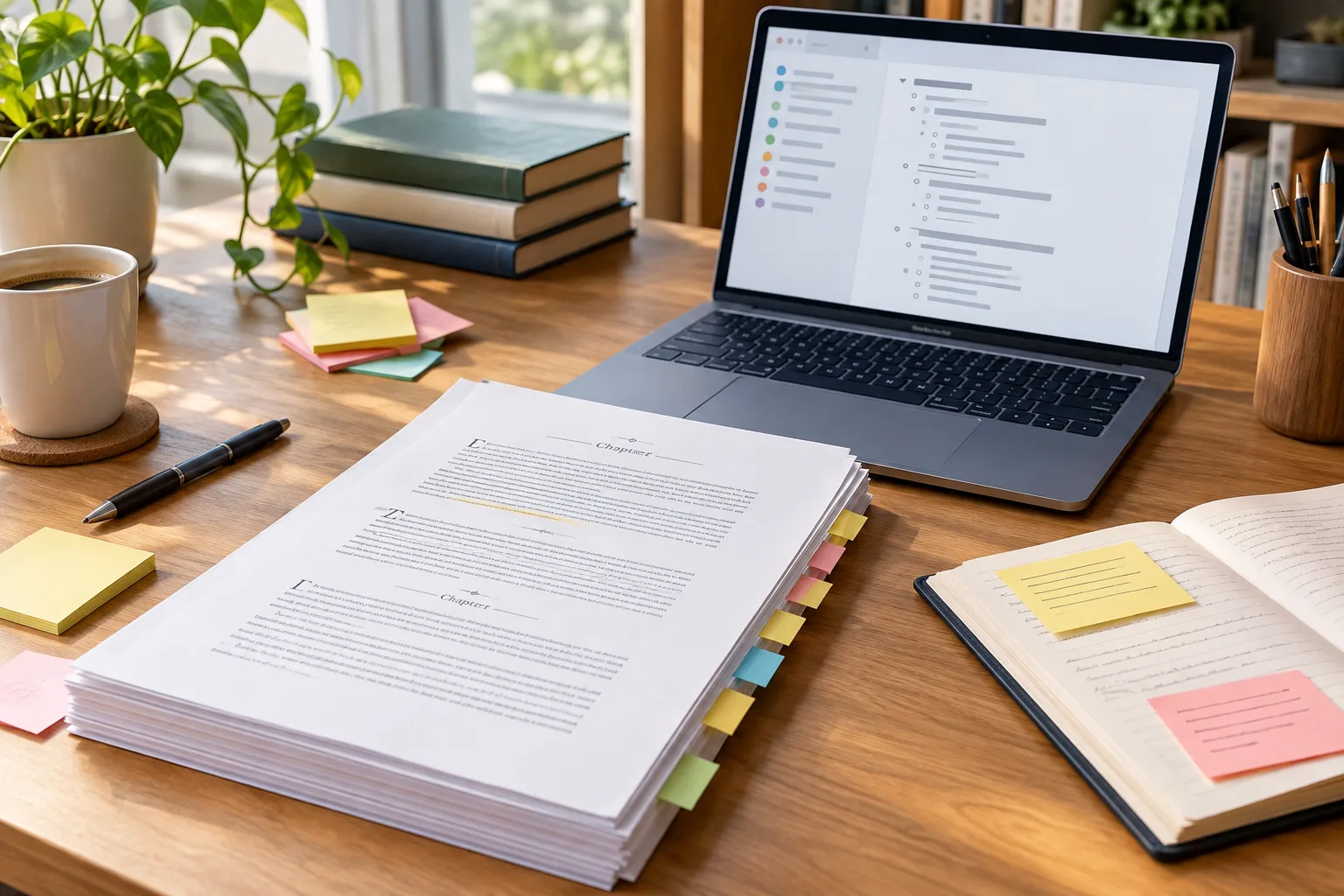
From draft to publishable manuscript
A manuscript is more than a finished story: it carries consistent scene breaks, front matter, and a clean heading structure. Those details determine how cleanly the file converts to print and ebook.
- Use Word styles, not manual formatting
- One space after periods
- Keep the story in one file
The manuscript format an editor and a formatter both expect
Standard manuscript format is a convention rather than a style choice: 12 pt serif type, double spacing, 1 in margins on all four sides, a half-inch first-line indent for new paragraphs, the author's surname and page number in the header, and chapter headings that begin on a new page. At those settings a full page holds about 250 words, which is the number every manuscript-to-book-page estimate is built on.
The file requirements are narrower and more mechanical. A DOCX built from paragraph styles converts cleanly; the same text with manual spacing, tabs used as indentation, or a blank line between every paragraph fails the structure check even when the story is finished. Keep one file for the whole book and let the styles carry the layout instead of the keystrokes.
- One space after a period, and no manual line breaks inside a paragraph
- Scene breaks marked consistently, never with empty paragraphs
- Chapter openings on a new page, with styled headings rather than bold text
| Typed manuscript page | Printed book page | |
|---|---|---|
| Settings | 12 pt, double spaced, 1 in margins | 11 pt, 1.2 line spacing |
| Words per page | about 250 | about 370 |
| 200 manuscript pages | about 50,000 words | about 142 book pages |
Checking the manuscript before upload
Upload the DOCX to the free formatter check. It inspects modeled structure, spacing, and image risks before you upload.
What belongs in the working file
The working manuscript should contain the text you intend to publish, not a folder of alternatives. Keep one approved file with the body, chapter headings, scene breaks, and any deliberate blank pages. Move title pages, copyright pages, and dedication pages into the edition stage unless your formatter expects them in the source.
Images are the other common source of drift. A manuscript with pasted screenshots, floating text boxes, or inconsistent image widths may convert differently from the same text without them. Inventory the images before layout and decide which ones are essential.
- One approved source file
- Real heading styles for chapters and sections
- Consistent scene-break markers
- A known list of images and captions
A ten-minute preflight before layout
Run the same checks every time. Accept or reject tracked changes, remove comments, confirm the heading structure, check for manual line breaks, and look for placeholder text. Then check the page size, margins, fonts, and image resolution. These are mechanical checks, not editorial ones, and they catch the failures that waste the most time later.
A clean preflight does not mean the book is ready to publish. It means the source is stable enough to lay out. The proof stage still checks the actual pages, the running heads, the table of contents, and the cover.
| Check | Why it matters | Where to fix it |
|---|---|---|
| Tracked changes | Unaccepted edits can ship | Word review pane |
| Comments | Private notes can leak | Word comments |
| Heading styles | Navigation and TOC break | Paragraph styles |
| Manual line breaks | Reflow produces broken lines | Find and replace |
| Image resolution | Print looks soft | Replace the source image |
| Fonts | Embedding or substitution fails | Export settings |
What changes after the manuscript becomes a book
The manuscript page and the printed page are different objects. A double-spaced 12 pt manuscript page holds about 250 words; a 6 x 9 in printed page at 11 pt with 1.2 line spacing holds about 370. The page count, gutter, and spine all change when the layout changes, even if the words do not.
That is why the manuscript page count is a planning number, not a print specification. Use it to estimate the book, then recalculate the interior and the cover after layout.
When to stop editing the source file
Stop editing the source when the remaining changes are layout changes. If you keep fixing spacing, page breaks, and running heads in the manuscript, the layout will keep breaking. Make those changes in the layout file, then proof the result.
Keep a clean copy of the approved manuscript. If a later export fails, you can return to the source instead of reconstructing it from the PDF.
FAQ
Frequently asked questions
What format should a manuscript be?
DOCX is the safest interchange format for KDP, built with paragraph styles rather than manual spacing.
When is a manuscript ready?
When the story is structurally edited and the file uses consistent styles. Layout and cover design come after.
What is standard manuscript format?
12 pt serif type, double spacing, 1 in margins, a half-inch first-line indent, and surname plus page number in the header — about 250 words per page. Keep it consistent, because editors and formatters both key off those settings.
How many book pages is a 200-page manuscript?
About 142 pages at 6 x 9 in with 11 pt type and 1.2 line spacing. 200 double-spaced manuscript pages is roughly 50,000 words, and the page calculator converts that into a planning range for your trim.
Does the manuscript include the front matter?
Not in the working file. The title page, copyright page, and dedication belong to the edition rather than the draft, so they are usually added once the text is final — the front matter generator writes both pages for you.
How long should a manuscript be?
It depends on the genre and the reader. A short business guide can be 20,000 words; a novel is often 70,000 to 100,000. The page calculator converts a word count into a planning range for your trim.
Was this publishing guide or tool helpful?
Put the definition to work for free.
Run your manuscript through the matching free check and see how the term applies to your own book.